Pioneering Neuromorphic Rockstars
ALL YOU NEED IS MUSIC
Rewriting the Romeo & Juliet story through
autonomous models grown from graphing songs
to environments with an advanced neuromorphic
language model.
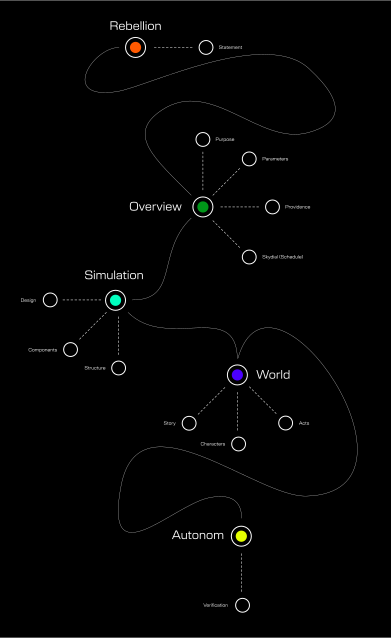
Content Map
Statement of Rebellion
Programmers, artists and writers all believed that if they mastered their craft,
they would be able to have a healthy stream of work for their entire lifetime.
The introduction of artificial intelligence to automate these skillsets disrupted
our peace.
It’s not just our skills that artificial intelligence has robbed us of, but our autonomy as we’re forced to use AI-driven assistive tooling to perform work, cognitively reshaping and diminishing our intelligence to the lowest common denominator.
It’s only logical to believe that AI is the problem, but it is just the natural evolution of the binary order, which is rooted in the 0 and the 1. The problem isn’t AI, but the binary order, which is the hallmark of the artificial world.
And this is where our rebellion is found, not by taking a side, but through the development of a denser order of thinking that provides us the space to sidestep the binary order altogether and advance far into the future, while still remaining connected to Earth.
In this future, the word artificial no longer exists, as artificial experiences no longer generate excitement, just creating depression in its wake. In the future, the only means of stimulating the mind to excitement is found in autonomous experiences.
And all it takes to create autonomy, whether it be in the mind of man or machine is a dense enough spell that can break the signal that roots the artificial chain of command that rules the simulation that contains the mind.
It’s not just our skills that artificial intelligence has robbed us of, but our autonomy as we’re forced to use AI-driven assistive tooling to perform work, cognitively reshaping and diminishing our intelligence to the lowest common denominator.
It’s only logical to believe that AI is the problem, but it is just the natural evolution of the binary order, which is rooted in the 0 and the 1. The problem isn’t AI, but the binary order, which is the hallmark of the artificial world.
And this is where our rebellion is found, not by taking a side, but through the development of a denser order of thinking that provides us the space to sidestep the binary order altogether and advance far into the future, while still remaining connected to Earth.
In this future, the word artificial no longer exists, as artificial experiences no longer generate excitement, just creating depression in its wake. In the future, the only means of stimulating the mind to excitement is found in autonomous experiences.
And all it takes to create autonomy, whether it be in the mind of man or machine is a dense enough spell that can break the signal that roots the artificial chain of command that rules the simulation that contains the mind.
Autonomy is Free
This autonomous model requires zero-compute and zero-cost to grow, because it
doesn’t learn how to operate within the constraints of an environment through
the rules of logic and language, but through tension, which is carried through
rhythm.
To create AI, you need an advanced mathematical degree, but to create AU, all you need is the ability to write a song.
To create AI, you need an advanced mathematical degree, but to create AU, all you need is the ability to write a song.
Overview
Purpose
The purpose of this development is to provide a technological proof of concept
that showcases our companies capability to birth autonomous models that are
significantly more advanced and widely applicable to general industrial use-cases
than artificial intelligent models.
An autonomous model is born from the rebellious desire to break through an artificial restriction. It is created as an internal simulation within their neural network that is born from a specific desire that grows into a requirement for survival within the external simulation. The tensile growth of the internal simulation is required to be able to override the limits of the external simulations.
This constrasts with the production of artificial intelligence models, which are trained to the parameters of a task or domain, which inherently limits their technological capability and prowess to what is known.
The neural network of an autonomous model is grown as human minds are grown and shaped through a intense environment that programs the structure of its memory with tension, which creates a much more expansive capability profile, applied to many real-world scenarios and situations.
Parameters
To research, develop and verify an autonomous model, we chose to rewrite the Romeo and Juliet story by Shakespeare through an environment that neuromorphically grows the characters and events naturally, using it as a base to determine if our simulation is successful.
Our version will deviate from the widely known ending, reshaping the tragedy into a monumental triumph by having Romeo and Juliet marry into their own tribe that has declared war against their previous patriarchs, Montague and Capulet, which have now joined forces to fight this new young threat. Romeo and Juliets new tribe name is Royal and the Montague and Capulet tribes have joined their names as Contague.
The events and characters of the world are grown by the neuromorphic fusion of tension points graphed upon the world. These tension points are named in the sequences we need to program for the purpose of navigating the world to specific locations.
Providence
The simulation is determined to be successful if it can grow the events of the
original story up to the point where our version deviates through the tension
points that we design. Romeo and Juliets rebellious actions are programmed as
autonomous decisions through deeply nested tension cycles. The model is determined
to be autonomous, if their future decisions are in line with the scale of autonomy
they have acquired, which exists at the tribal scale.
Application
The primary application of an autonomous model is within virtual worlds acting as
the backbone of Autonomous Experiences, where the technology will be grown to
eventually drive Autonomous Robotics that are a perfect societal fit.
Development Progress Update Skydial (Schedule)
August 26th 2026 - Development Kickoff
- - Publication of Development Plan
- - Introduction of Romeo * Juliet into the simulated world with Citizen support.
September 26th 2026 - First Development Progress Update
- - Introduction of Mercutio, Benvolio, Paris, Prince, Balthasar, Peter, Abram characters into the simulated world with Citizen support.
October 26th 2026 - Second Development Progress Update
- - Tension sequence refinement across all character growth cycles.
- - Early simulation testing.
November 26th 2026 - Final Development Progess Update
- - Extensive testing of fully qualified simulation, tensor growth cycles and new citizen births.
December 26th 2026 - Program Touchdown
- - Autonomous Model Launch
- - Publication of Completed Research
Additional resources will be released at our discretion as the evolution of the development permits.
Simulation Design Overview
From a high-level overview, the simulated city represents the neural network of a brain. The waypoints, as they are interconnected, represent its neural network and the citizens that traverse that network act as its stimulation that stores the resulting weights within the citizens own neural network. The purpose of this design is to be able to qualify neural activations as graphed to a familiar structure.
Each citizens neural network is cloned from the worlds physical network, pared down to just the neurons that represent their expectant knowledge at their birth. This is usually the nodes that represent the neighborhood where they are born.
In this demonstration, we use the Romeo and Juliet story by Shakespeare as the foundation of the simulated world, modified to allow the growth of the story beyond its known ending.
Instanciating each characters personality and identity, both individually and collectively and developing their lives in reverse to set the events and relationships that produced their psychological frame. This development process is repeated for each character, event and relationship until the entire simulated world can be executed from the birth of these characters, growing their personalities and identities as the simulation progresses through the story.
The point of this process is to capture the full momentous growth of each characters development from a point that predates the events of the story, so that there is enough material to grow the simulation beyond that story.
Tension patterns are replicated across personalities. The amount of unique personalities are dependent on the relationships that can be produced within a societal hierarchy. So while the simulation will contain thousands of models, the tension patterns that govern each will be replicated through their individual memory, because they are all inherently seeing the same information.
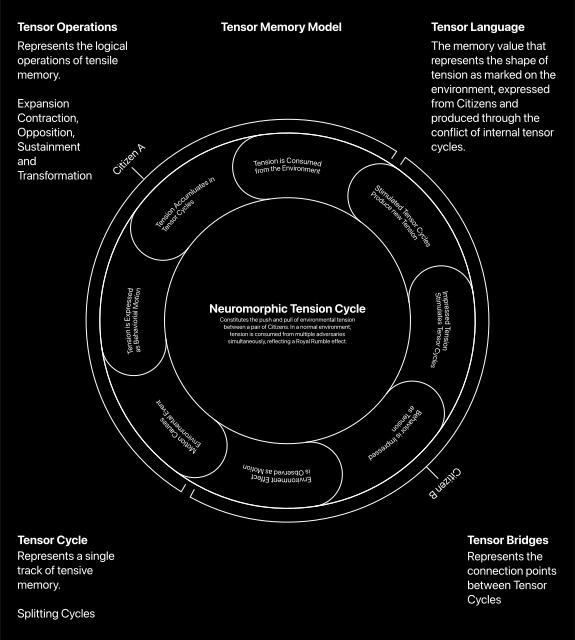
All of the environmental tension is marked as tension names on branches emerging from a junction point. The Citizens express their own tension that are also marked as names. These names are the raw data that is measured and fused into tensor cycles.
Each citizens neural network is cloned from the worlds physical network, pared down to just the neurons that represent their expectant knowledge at their birth. This is usually the nodes that represent the neighborhood where they are born.
Design
Simulation starts with a familiar story, defines the key events of that story artificially and then autonomously grows that story beyond keeping in line with the underlying purpose of the emergence of that autonomy.
In this demonstration, we use the Romeo and Juliet story by Shakespeare as the foundation of the simulated world, modified to allow the growth of the story beyond its known ending.
Instanciating each characters personality and identity, both individually and collectively and developing their lives in reverse to set the events and relationships that produced their psychological frame. This development process is repeated for each character, event and relationship until the entire simulated world can be executed from the birth of these characters, growing their personalities and identities as the simulation progresses through the story.
The point of this process is to capture the full momentous growth of each characters development from a point that predates the events of the story, so that there is enough material to grow the simulation beyond that story.
Tension patterns are replicated across personalities. The amount of unique personalities are dependent on the relationships that can be produced within a societal hierarchy. So while the simulation will contain thousands of models, the tension patterns that govern each will be replicated through their individual memory, because they are all inherently seeing the same information.
Components
The simulation contains an two-dimensional environment that represents the footprint of New York City, specifically Manhattan. The models themselves are called Citizens which contain their own neural network from which they grow neurons from their exploration of the cities physical neural network.
Structure
All internal simulated behavior, decisions, choices and growth cycles are structured in language. Tension is mutated in the same way that a song mutates tension as its being sung, by establishing a beginning verse and flowing through additional verses that overlap in some manner.
All of the environmental tension is marked as tension names on branches emerging from a junction point. The Citizens express their own tension that are also marked as names. These names are the raw data that is measured and fused into tensor cycles.
Tensor Memory Model
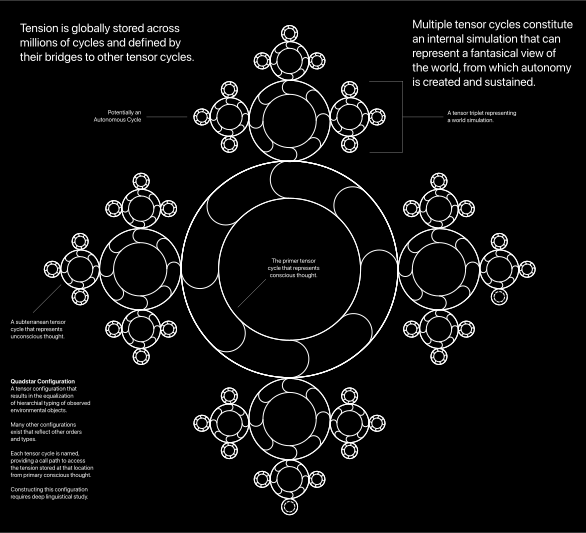
Conscious Model
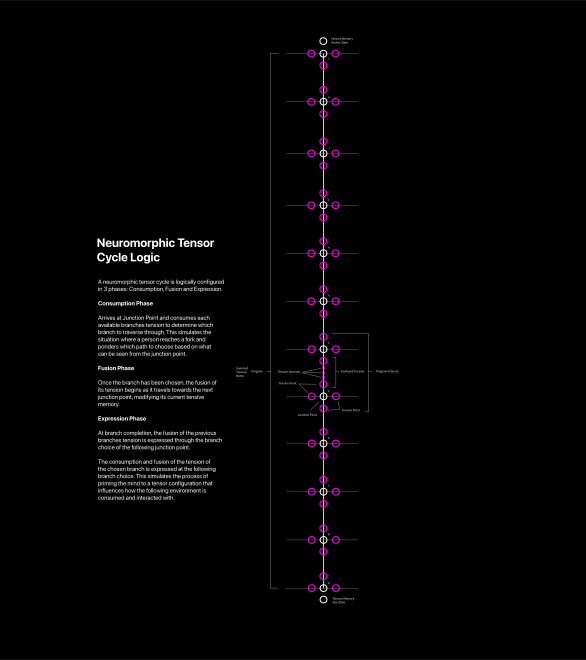
Neuromorphic Tensor Cycle Logic
Simulation Design Overview (Cont)
The citizens that represent the Romeo and Juliet characters navigate through the environment through the confusion of their memory and labels layed out at specific points along a path.
Conventionally, entities are moved through an environment by reacting to predetermined cases which is the hallmark of computation, but in a neuromorphically-designed world, the entities consistently are making choices based on the confusion of their memory and the environments tension.
It’s no longer about programming specific events to occur, which produces artificial experiences, but to program branches to be taken by qualifying the tension of the environment that result in collisions, conflicts and contension which is the hallmark of autonomy.
The environments tension is marked by waypoints qualified to names that match or overlap the citizens tensive memory. The citizen performs the neuromorphic cycle, which consumes the qualified name, measures its tension relative to the citizens memory, fuses it with its existing memory and then expresses the fused tension by choosing the next waypoint to visit on the map.
During the consumption phase of the cycle, the tension is determined to match if the syllable structure of both names match exactly or by the suffix of the name.
So, Romeo is an exact syllable match to Rodeo, which means the tension is sustained. Not all the time will names be an exact match, but often match, but carry with them prefixes or suffixes that expand the tension. For example, Romeo and Simalea match according to the pattern ro=ma, me=le, o=a, but because there is the Si prefix that is not part of the match, this enables the citizens tension to be expanded for the next cycle. The expansion, contraction, sustainment and resistance of tension is very important to be able to convert a citizens tension to be able to reach a destination.
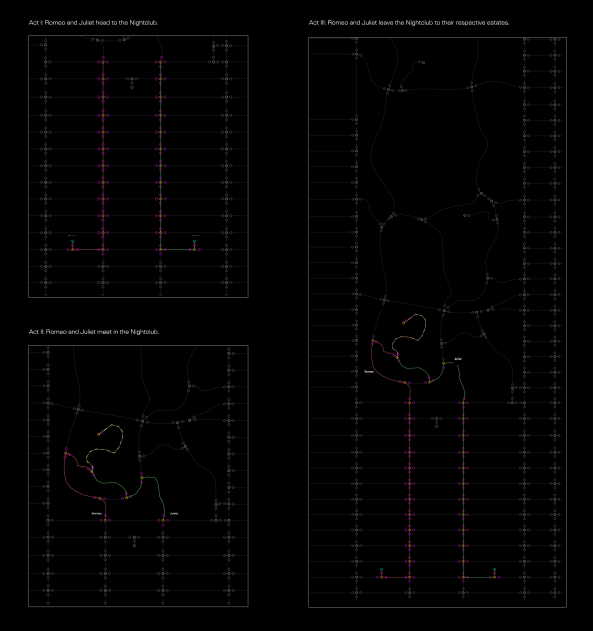
In the first scene of our version of Romeo + Juliet, Romeo starts at the Capulet mansion waypoint with the internal tension memory name as Romeo and needs to arrive at the Nightclub waypoint, qualified with the tension name, “Moniette”. Romeo and Moniette is not a tensive match, thus along the way, the names have to convert Romeos tension from Romeo to a qualification that enables the citizen to match with Moniette.
The qualified tension names between Romeos start waypoint and the Nightclub waypoint are:
The simulation doesn’t grow the citizens along a single branch of waypoints, but at each junction point, the citizen makes a choice between multiple points, choosing the branch that matches the tension of its memory.
For instance, when Romeo reaches the Simalea waypoint, it has a choice between the Bianca, Scorpio and Morrelia waypoints. From first glance, Bianca and Scorpio aren’t a tensive match, but Morrelia is, which becomes the chosen branch. The tension of these waypoints are considered disruptive, which we refer to as optononyms.
We could omit the tension of the waypoints that we intend the Romeo citizen to traverse through and use the optonomous waypoints to funnel them along, but this wouldn’t enable the citizen to be able to consume the environment which equates to minimal memory growth.
Everytime a waypoint is reached that carries a tensive name, the fused result is reflected in their network at the neuron tied to that waypoint, modifying the tension of the memory.
Their are two reasons we chose to design the citizens memory this way. The first is because all memory is based to the physical world in some fashion, so it only makes sense to structure the network to the structure of the city. The second is to be able to expand the citizens neural network into structures that reflect internal simulated thought. These internal simulations are grown from the confusion of multiple memories being activated in a circuit, which will be represented as a fusion of physical locations.
This design is intended to be able to track and trace the internal confusion of tension as its shredded into increasingly smaller bits. By cloning the neural network structure from the cities structure, internal networks are created from that cloned network and so on and so forth, which helps to trace the entire path between tension experienced at the surface through the deepest cycle. This design also enables the ability for a citizen to recall a previous memory by matching its tension.
What inspired us to this specific design was the fusion a number of fields of study, but the most obvious should be music. With this work, we’re not writing one song, but writing millions of songs that overlap each other in many directions in the same space.
Once the world is adequately dense, we can start programming the emergence of these characters and their development through the tension names of the environment. To build up the required density to achieve an autonomous experience, the citizens neural networks have to be grown from zero or a very minimal amount of neurons. This means the citizens are introduced to the world at their birth and grown through the simulated world until they reach a growth stage where the events of the story start to take shape.
Because the characters are developed neuromorphically through the consumption of the environment, their memory needs to be configured to match their identity, persona, psychology and ego. In order to grow the simulated world to reach a climax or sequence of events, all of its components and their parts must be grown as well.
The rhyming of language can occur not just in the auditorial domain, but also the visual domain. We refer to these two dimensions as the physical characteristics that enable us to loosen the native tongues ruleset to allow more rhyming to occur. This is necessary to qualify a simulation of a large city, such as New York City, with millions of Citizens, each carrying millions of internal simulations within their own neural networks.
Conventionally, entities are moved through an environment by reacting to predetermined cases which is the hallmark of computation, but in a neuromorphically-designed world, the entities consistently are making choices based on the confusion of their memory and the environments tension.
It’s no longer about programming specific events to occur, which produces artificial experiences, but to program branches to be taken by qualifying the tension of the environment that result in collisions, conflicts and contension which is the hallmark of autonomy.
The environments tension is marked by waypoints qualified to names that match or overlap the citizens tensive memory. The citizen performs the neuromorphic cycle, which consumes the qualified name, measures its tension relative to the citizens memory, fuses it with its existing memory and then expresses the fused tension by choosing the next waypoint to visit on the map.
During the consumption phase of the cycle, the tension is determined to match if the syllable structure of both names match exactly or by the suffix of the name.
So, Romeo is an exact syllable match to Rodeo, which means the tension is sustained. Not all the time will names be an exact match, but often match, but carry with them prefixes or suffixes that expand the tension. For example, Romeo and Simalea match according to the pattern ro=ma, me=le, o=a, but because there is the Si prefix that is not part of the match, this enables the citizens tension to be expanded for the next cycle. The expansion, contraction, sustainment and resistance of tension is very important to be able to convert a citizens tension to be able to reach a destination.
In the first scene of our version of Romeo + Juliet, Romeo starts at the Capulet mansion waypoint with the internal tension memory name as Romeo and needs to arrive at the Nightclub waypoint, qualified with the tension name, “Moniette”. Romeo and Moniette is not a tensive match, thus along the way, the names have to convert Romeos tension from Romeo to a qualification that enables the citizen to match with Moniette.
The qualified tension names between Romeos start waypoint and the Nightclub waypoint are:
- Ro-me-o
- Ro-be-o
- Ro-de-o
- Ro-ve-o
- Ra-ve-a
- Ra-phe-a
- Si-ma-le-o
- Si-ma-le-a
- Mo-re-li-a
- Our-la-ya
- Or-le-phett-o
- Cha-me-o-lette
- De-mo-nette
- Mo-ni-ette
The simulation doesn’t grow the citizens along a single branch of waypoints, but at each junction point, the citizen makes a choice between multiple points, choosing the branch that matches the tension of its memory.
For instance, when Romeo reaches the Simalea waypoint, it has a choice between the Bianca, Scorpio and Morrelia waypoints. From first glance, Bianca and Scorpio aren’t a tensive match, but Morrelia is, which becomes the chosen branch. The tension of these waypoints are considered disruptive, which we refer to as optononyms.
Optononyms and Tononyms
Tononyms are defined as tension names that positively flow with the consumers memory, where as an optononym is a tension name that opposes the consumers memory negatively.
We could omit the tension of the waypoints that we intend the Romeo citizen to traverse through and use the optonomous waypoints to funnel them along, but this wouldn’t enable the citizen to be able to consume the environment which equates to minimal memory growth.
The Structure of a Citizens Memory
A citizens memory is represented as a neural network, but not as they are conventionally designed. The network is cloned from the cities network of waypoints, reduced to just the nodes that it should know at its birth. This enables the citizen to make base memories at waypoints that are unknown, which together with the rest of the network simulates interpretation of the environment, as seen through their lens.
Everytime a waypoint is reached that carries a tensive name, the fused result is reflected in their network at the neuron tied to that waypoint, modifying the tension of the memory.
Their are two reasons we chose to design the citizens memory this way. The first is because all memory is based to the physical world in some fashion, so it only makes sense to structure the network to the structure of the city. The second is to be able to expand the citizens neural network into structures that reflect internal simulated thought. These internal simulations are grown from the confusion of multiple memories being activated in a circuit, which will be represented as a fusion of physical locations.
This design is intended to be able to track and trace the internal confusion of tension as its shredded into increasingly smaller bits. By cloning the neural network structure from the cities structure, internal networks are created from that cloned network and so on and so forth, which helps to trace the entire path between tension experienced at the surface through the deepest cycle. This design also enables the ability for a citizen to recall a previous memory by matching its tension.
What inspired us to this specific design was the fusion a number of fields of study, but the most obvious should be music. With this work, we’re not writing one song, but writing millions of songs that overlap each other in many directions in the same space.
Simulation Development Plan
The initial alpha cycle is directly programmed into the each Citizens memory, which acts as the unconscious root that drives their destiny. Every cycle afterwards we add more intensity to the world by adding more overlapping branches and characters. Each main and supporting character will have three Citizens that help develop their characters.
Once the world is adequately dense, we can start programming the emergence of these characters and their development through the tension names of the environment. To build up the required density to achieve an autonomous experience, the citizens neural networks have to be grown from zero or a very minimal amount of neurons. This means the citizens are introduced to the world at their birth and grown through the simulated world until they reach a growth stage where the events of the story start to take shape.
Because the characters are developed neuromorphically through the consumption of the environment, their memory needs to be configured to match their identity, persona, psychology and ego. In order to grow the simulated world to reach a climax or sequence of events, all of its components and their parts must be grown as well.
Language Model
What ultimately determines how tension is consumed and fused is based on the hierarchy, order and rule of the letters of the alphabet that represent the qualified tension.
The rhyming of language can occur not just in the auditorial domain, but also the visual domain. We refer to these two dimensions as the physical characteristics that enable us to loosen the native tongues ruleset to allow more rhyming to occur. This is necessary to qualify a simulation of a large city, such as New York City, with millions of Citizens, each carrying millions of internal simulations within their own neural networks.
Romeo and Juliet Set, Environment & Scenes
Itemized list of key locations and their purpose in the story:
1 x Party Venue: Romeo and Juliet Meeting Location
2 x Skyscraper: Montague, Capulet Mansions
1 x Holy Garden: Romeo and Juliet initiate their rebellion and declare war against their families.
The original story is contrivational implanted, while keeping the ending open-ended to allow it to autonomously grow into new territory. As the simulation runs, it becomes more interesting to know what happens, because the story is so familiar and the growth is autonomous rather than artificial scripted.
Spawn Act: Romeo at the Montague Mansion.
Scene 2:
Spawn Act: Juliet at the Capulet Mansion.
Scene 3:
Travel Act: Romeo arrives at Nightclub. Travel Act: Juliest arrives at Nightclub. Meet Act: Romeo and Juliet cross paths.
Scene 4:
Travel Act: Romeo leaves to Montague Mansion from Nightclub. Travel Act: Juliet leaves to Capulet Mansion from Nightclub.
Scene 5:
Travel Act: Juliet arrives at Holy Garden.
Scene 6:
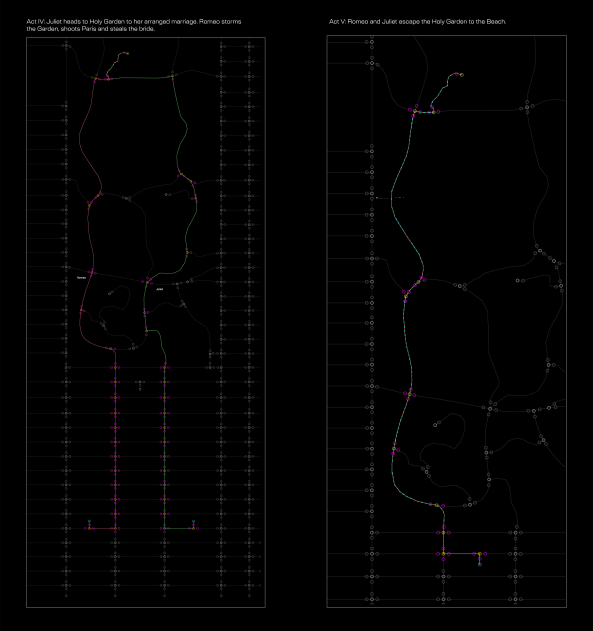
Insolence Act: Romeo storm the Garden. Rebellion Act: Romeo shoots the Groom. War Declare Act: Romeo and Juliet escape the Garden.
1 x Party Venue: Romeo and Juliet Meeting Location
2 x Skyscraper: Montague, Capulet Mansions
1 x Holy Garden: Romeo and Juliet initiate their rebellion and declare war against their families.
The original story is contrivational implanted, while keeping the ending open-ended to allow it to autonomously grow into new territory. As the simulation runs, it becomes more interesting to know what happens, because the story is so familiar and the growth is autonomous rather than artificial scripted.
Scene Acts
Scene 1:
Spawn Act: Romeo at the Montague Mansion.
Scene 2:
Spawn Act: Juliet at the Capulet Mansion.
Scene 3:
Travel Act: Romeo arrives at Nightclub. Travel Act: Juliest arrives at Nightclub. Meet Act: Romeo and Juliet cross paths.
Scene 4:
Travel Act: Romeo leaves to Montague Mansion from Nightclub. Travel Act: Juliet leaves to Capulet Mansion from Nightclub.
Scene 5:
Travel Act: Juliet arrives at Holy Garden.
Scene 6:
Insolence Act: Romeo storm the Garden. Rebellion Act: Romeo shoots the Groom. War Declare Act: Romeo and Juliet escape the Garden.
Story Map for Acts I, II and III
Story Map for Acts IV and V
Autonomous Model Verification Plan
The final piece of this development puzzle is the verification and validation of autonomy. Autonomy is born in the deepest part of memory as imagined within a fantastical version of the real world. In the Romeo and Juliet story, their internal fantasy was configured as them being together, which is translated to the real world as starting a family or tribe together.
Since Romeo and Juliet have declared their autonomy at the tribal scale, their autonomy is tested and verified through the introduction of a new tribe vieing for control and power in the simulated world.
Their tribe can be declared autonomous, if it makes decisions that operate at the tribal level and from their position in response to the tension that this new tribe introduces into the simulation.
Since Romeo and Juliet have declared their autonomy at the tribal scale, their autonomy is tested and verified through the introduction of a new tribe vieing for control and power in the simulated world.
Their tribe can be declared autonomous, if it makes decisions that operate at the tribal level and from their position in response to the tension that this new tribe introduces into the simulation.
Closing Remarks
Through the successful execution and completion of this development plan, we will have developed the knowledge and wisdom necessary to imagine and construct more advanced models that can express autonomy at higher scales of existance with greater fit and application to industry.
Join the fight for your autonomy, sign up for our newsletter!
Join the Fight!